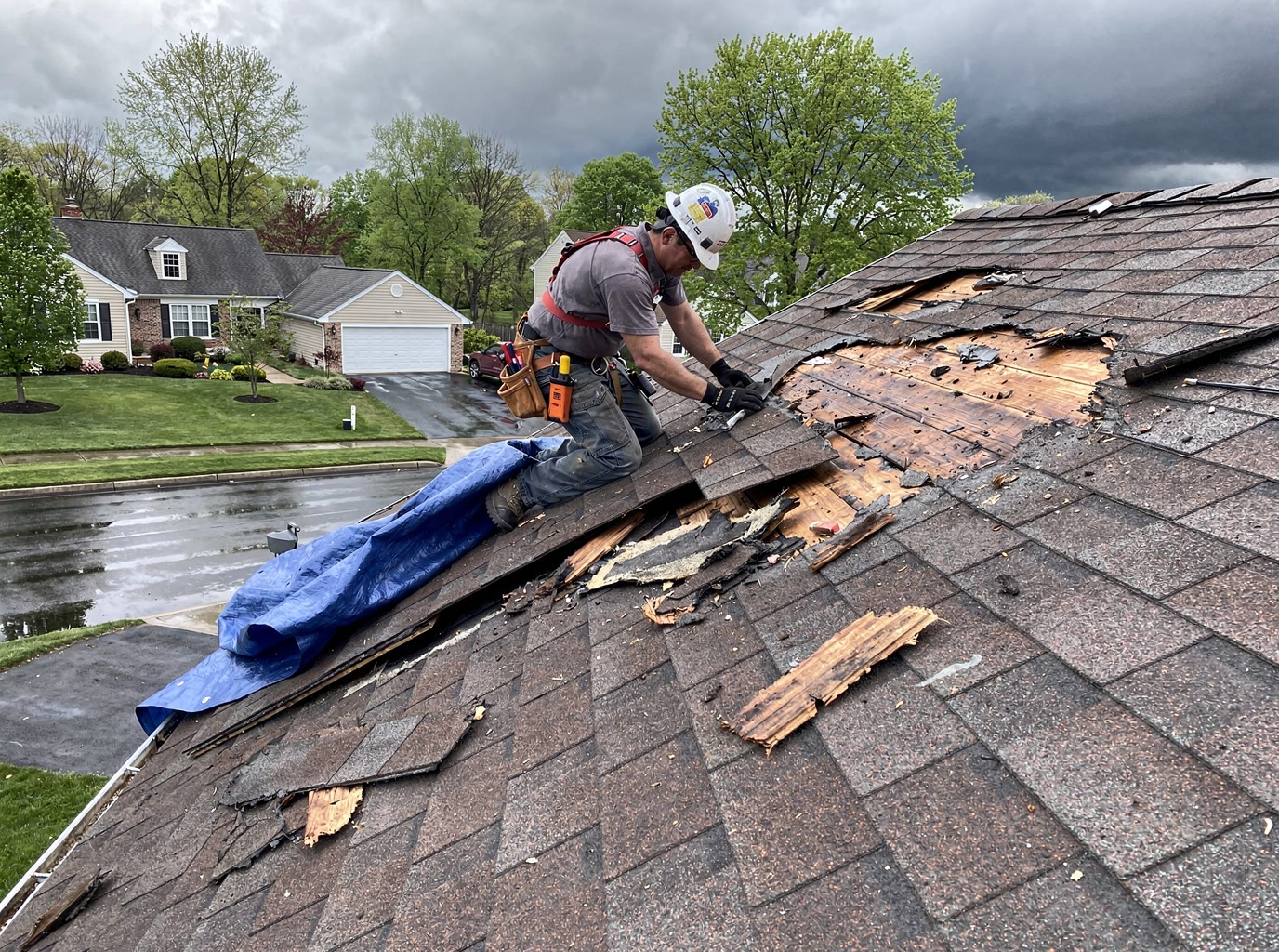
Hot, humid summers in Newtown Square bring fast-moving thunderstorms that peel starter courses and lift ridge caps on older colonials and split-levels from Edgemont through Gradyville. Cold winters then freeze meltwater in valleys that already sat wet after a summer cell. We work those roofs from 3475 West Chester Pike, walking every plane after a blow so we catch creased tabs and popped nails before the next rain soaks the deck. Mature oaks near Tyler Arboretum drop limbs that punch holes a homeowner never sees from the driveway. Nearby Media, Broomall, and Wayne share the same mix of 1950s–1970s stock and later infill, so flashing at chimneys and dormers is often original and already tired before the storm hits.
Wind does not treat a hip roof the same as a gable facing the Newtown Square Corporate Campus. On gables we often find the rake edge failed first, then water tracked under the felt. Hail bruises asphalt so the granule loss shows as dark spots; those spots become leaks two winters later when freeze-thaw opens the mat. We never guess from the ground. A full walk, attic check for wet sheathing, and photos of every damaged course are how we decide patch versus plane. Ice dams after a nor’easter are common on north slopes that stay shaded; that is a different repair than a summer wind event and needs ice-and-water membrane, not just new shingles.
Delaware County code and typical HOA rules in these neighborhoods expect like-for-like appearance on street-facing slopes. We match existing architectural shingles when a partial is still sound, and we tell you when the rest of the roof is too far gone to patch honestly. Emergency board-up and tarping happen the same day when a tree is through the deck; we do not leave a house open overnight. Hours are Monday–Friday 8am–6pm and Saturday 9am–2pm so you can reach us after a weekday storm without waiting until Monday. Owner-operated work means you talk to the person who will be on the roof, not a call center.
After a Storm: What We Check First
We start at the eaves and rakes, then valleys, then penetrations. Lifted drip edge and missing ridge vent pieces are the usual first failures here. We look in the attic for daylight and damp insulation, then photograph every plane for your records. If a limb is still on the roof, we coordinate safe removal before we open anything. Partial repairs only make sense when the remaining shingles have life left; otherwise we say so up front.
Technician insight
In Newtown Square the thing that catches most people out is a summer cell that only lifts a few tabs on the back slope while the street face still looks fine. Those tabs sit over original felt on 1960s and 1970s houses; the next freeze after a wet fall opens the deck. I always walk the north and west planes near the trees by Tyler Arboretum even when the homeowner only noticed a leak at the front gutter.
Limb through a Gradyville ranch after a July cell
A homeowner called after a thunderstorm dropped a limb through the rear slope. We found three squares of creased tabs and a hole in the deck, plus wet insulation in the attic. We tarped the same afternoon, replaced the damaged sheathing, and rebuilt the course with ice-and-water in the valley. The rest of the roof was still sound, so we did not push a full tear-off.
Storm Damage Roof Services We Offer
✓Storm Damage Roof Inspection
Full walk of every slope, attic check, and photo set after wind or hail so you know what failed and what still holds.
✓Emergency Tarp and Board-Up
Same-day cover when a tree or wind opens the deck, so rain does not soak insulation overnight in Newtown Square.
✓Wind-Damaged Shingle Replacement
Replace creased, missing, or lifted tabs and reseal the course so the next storm does not peel a larger area.
✓Hail Damage Repair
Identify bruised mats and granule loss, then replace damaged courses before freeze-thaw turns bruises into leaks.
✓Insurance Claim Photo Documentation
Clear, labeled photos of each damaged plane and penetration so you can submit a complete claim without a second visit.
✓Full Roof Replacement After Storm
Tear-off and new underlayment, ice-and-water, and shingles when the existing roof is too far gone to patch honestly.
✓Valley Flashing and Gutter Storm Repair
Reset or replace torn valley metal and pulled gutters so water leaves the roof instead of backing into the fascia.
Storm Damage Roof Cost in Newtown Square, PA
| Service | Typical Range | What Affects It |
|---|---|---|
| Storm damage inspection and photo set | $150–$350 | Steep pitch, multiple wings, or heavy debris on the roof move it up. |
| Emergency tarp / board-up | $250–$700 | Hole size, height, and whether a limb must be cleared first. |
| Wind or hail shingle course repair | $400–$1,800 | Number of squares, access, and whether underlayment is torn. |
| Valley or flashing storm repair | $350–$1,200 | Metal vs. woven valley and how much adjacent shingle must come off. |
| Full tear-off and reroof after storm | $8,000–$18,000+ | Squares, pitch, layers, ice-and-water, and deck repairs found after tear-off. |
Ranges are typical for Newtown Square, PA and confirmed with an exact written quote before any work starts.
How it works
- 1
Call And Same-Day Or Next-Day Walk
You reach us during posted hours. We schedule a roof and attic walk, note storm type, and flag any open holes that need a tarp first.
- 2
Document Every Plane
We photograph rakes, ridges, valleys, and penetrations, then check the attic for wet sheathing so the scope is complete, not guessed from the street.
- 3
Honest Scope: Patch Or Replace
We tell you which courses can stay and which cannot. Partial work only when the rest of the roof still has service life.
- 4
Repair Or Tear-Off
Tarps come off once materials are on site. We replace damaged shingles or strip to the deck, add ice-and-water in valleys, and match the street face as closely as stock allows.
- 5
Final Walk And Photos
You get a walk-through of the finished planes and a photo set of the completed work for your records.
Pricing
Storm work is scoped after we walk the roof; small shingle repairs cost less than a plane or a full tear-off. We give a written range before we start, not a surprise after the dumpster arrives.