2026-09-02 ·
Roof Leak Repair Cost: A Complete Pricing Breakdown
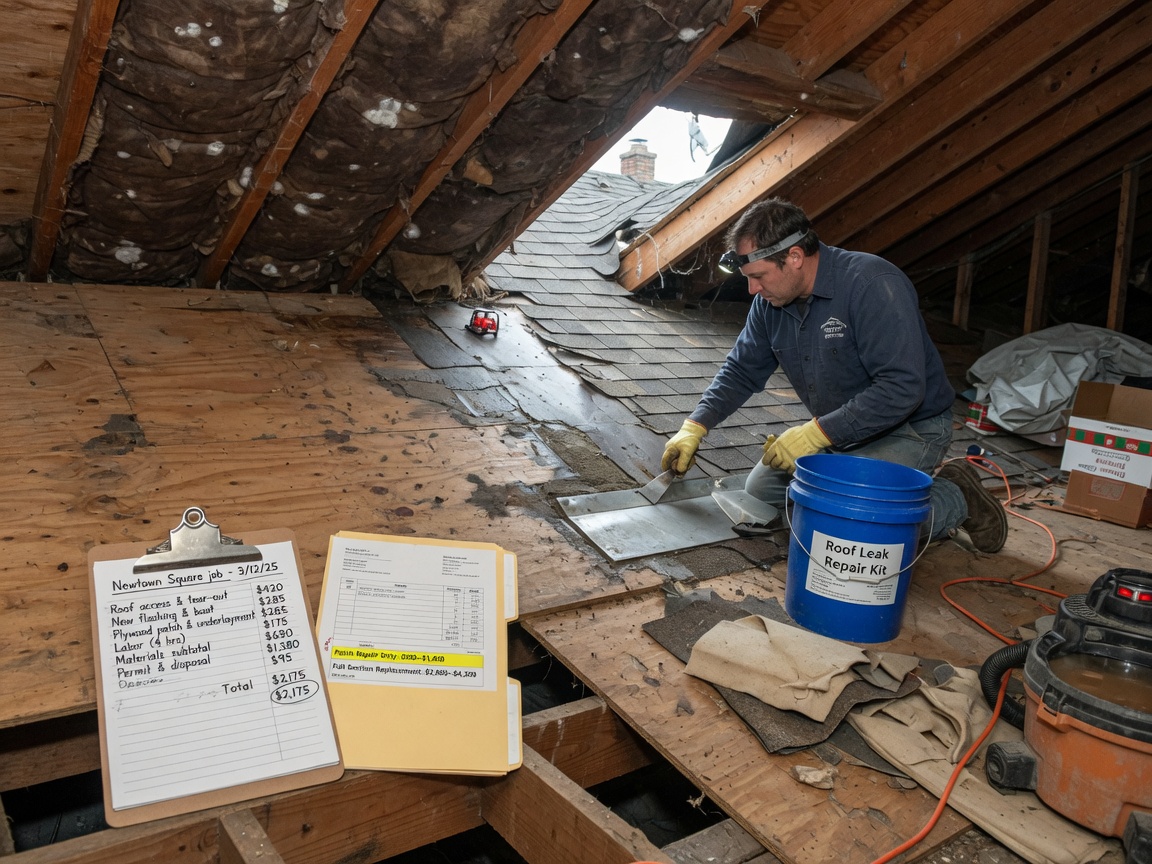
Most roof leak repairs in Newtown Square cost $250–$850 for a typical flashing, pipe-boot, or shingle patch, while chimney, valley, or multi-plane leaks often land at $800–$2,000. After-hours emergency tarps and temporary seals sit toward the top of those ranges. The spread comes from Delaware County labor rates, access on older two-story colonials in Edgemont and Gradyville, and freeze-thaw that opens seams once winter temperatures drop. A small stain on a first-floor ceiling is rarely a $150 caulk job; water has usually traveled. Newtown Square Roofing Inc works from 3475 West Chester Pike and can inspect Monday–Friday 8am–6pm or Saturday 9am–2pm so you see the source before you spend.
Typical Price Ranges for Common Leak Repairs
A single missing or cracked asphalt shingle on a reachable slope usually bills $250–$450, including matching architectural shingles common on streets near the Newtown Square Corporate Campus. Replacing a failed pipe boot or vent flashing runs $300–$550 because the plumber’s collar and underlayment must be resealed, not just the rubber. Step flashing along a sidewall or dormer typically costs $400–$750 on the 1½-story homes that line Gradyville Road; each course has to be woven correctly or the leak returns with the next nor’easter. Chimney flashing rebuilds are $650–$1,400 depending on whether the counterflashing is cut into the masonry. Valley metal replacement on a steep colonial can reach $900–$1,800 because both planes of shingles are lifted. Interior drywall and insulation are extra if staining has already reached living space. These figures assume daylight access and no full tear-off; they are the numbers homeowners in Media and Broomall actually see on invoices for roof leak repair work.
What Local Housing and Terrain Do to the Bill
Much of Newtown Square, Edgemont, and Gradyville stock dates from the 1950s–1980s: 6/12 to 10/12 pitches, mixed asphalt and occasional remaining cedar, and chimneys that sit at the ridge. Those roofs were built before ice-and-water shield was standard, so leaks often start at eaves and valleys after ice dams form. Clay soils hold moisture against foundations, which is why fascia and drip-edge rot show up together with the leak. Trees around Tyler Arboretum drop needles and seed pods that clog gutters; standing water then backs under the first course. Two-story access means extra ladder time and sometimes a second tech, adding $75–$150 to labor. Homes closer to Wayne and Broomall share the same pattern: original flashing that has outlasted the shingles around it. A repair that looks like “three shingles” from the ground can require lifting a 4-foot run to get underlayment dry. That is why a walk-around quote beats a phone estimate every time.
How Delaware County Weather Changes Repair Scope
Humid subtropical summers push attic temperatures high enough that shingles become brittle by year 15–18, so a leak that starts as a nail pop can tear a larger hole in a wind event. Cold winters then drive freeze-thaw through any open seam; ice dams along north-facing eaves in Edgemont are a yearly complaint. Spring rains after a freeze cycle expose flashing that looked fine in October. A same-day patch in January may need a follow-up once temperatures stay above freezing so sealants can cure. Storm-driven leaks after a summer thunderstorm often involve more than one plane because wind-driven rain finds the same weak flashing that ice found in February. That is why many roof repair visits include both the visible hole and a check of adjacent valleys. Budget a 10–20% contingency if the leak appeared after a freeze or a heavy rain; the first hole is rarely the only one. Regular roof maintenance catches those openings before they become interior damage.
When a Leak Repair Becomes a Larger Project
If more than 20–30% of a slope is brittle, or if the leak sits in a valley that has already been patched twice, replacing that section or the whole roof is cheaper than another round of patches. Overlaying new shingles over existing ones is rarely wise here because the extra weight and trapped moisture shorten the new layer. Homes near Media that still have original felt underlayment often need ice-and-water shield at eaves when the leak is at the drip edge. A $600 flashing job that reveals wet decking can jump to $1,200–$2,500 once plywood is replaced. Interior mold or stained insulation adds drywall and HVAC-filter work that is not roofing. If the roof is already at 18–22 years on a 25-year shingle, ask for a side-by-side of repair versus roof installation so you are not paying twice in 24 months. Honest quotes list both paths; the cheaper short-term number is not always the cheaper five-year number.
Getting a Quote You Can Trust and Next Steps
Ask for a written scope that names the leak source, the materials, and whether interior drying is included. Photos of the actual flashing or boot, not just the ceiling stain, keep everyone honest. Compare apples to apples: one contractor’s $400 “seal” may be the other’s $700 flashing rebuild. Newtown Square Roofing Inc is owner-operated from 3475 West Chester Pike; we give upfront numbers after we are on the roof, not from a driveway glance. If you are in Broomall or Wayne the same weather and housing patterns apply, so the ranges above still hold. Schedule during weekday hours when we can get on the roof safely; Saturday mornings work for inspections if the leak is active. A tarp is not a repair. Once the source is dry, match the remaining shingles so the patch does not telegraph. Keep the invoice and photos; they matter if a later storm claim arises. That is the complete pricing picture for roof leak work in this part of Delaware County.