2026-09-02 ·
Leaking Concrete Roof: Causes and Repair Options
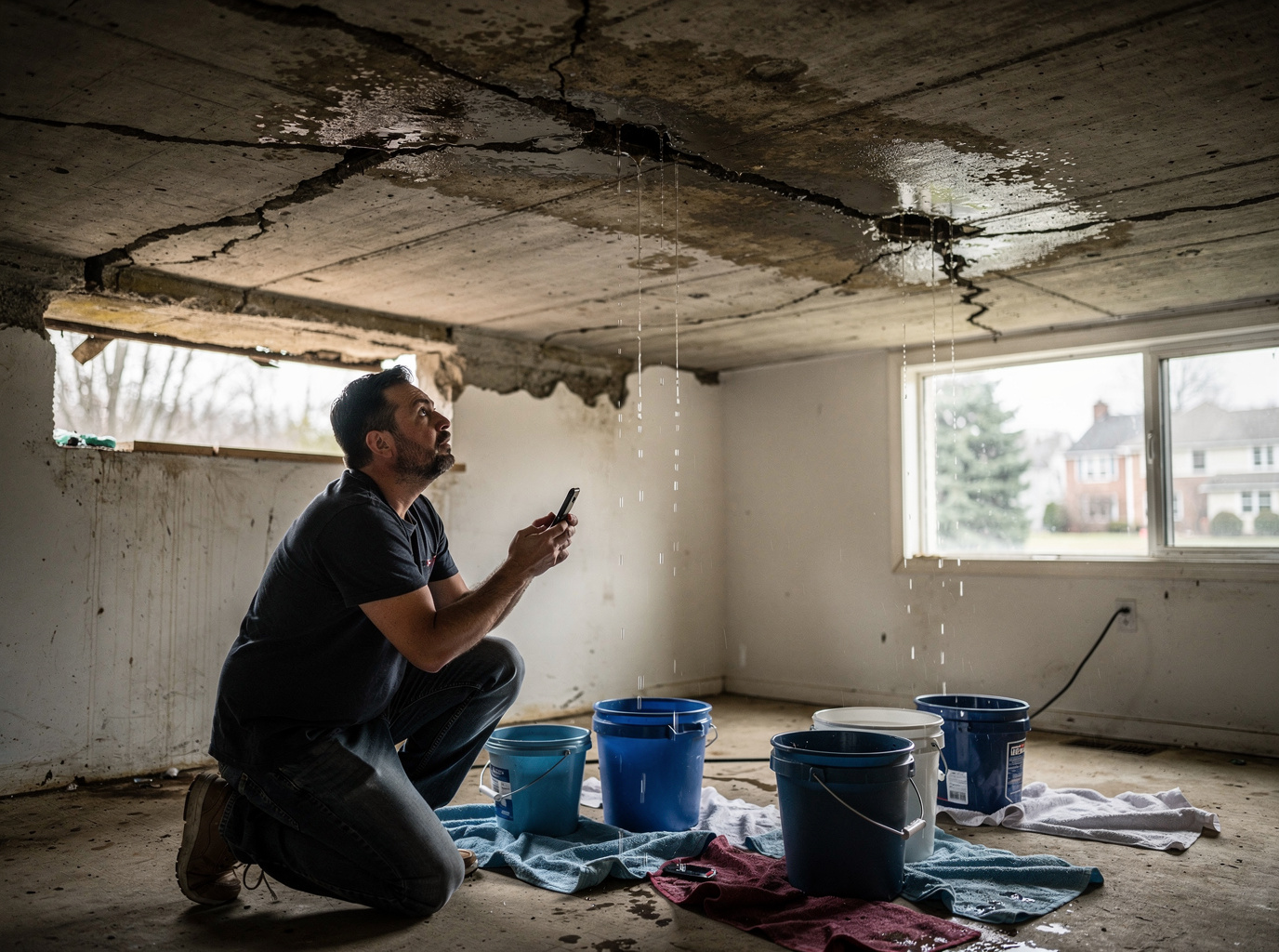
Concrete roofs leak when hairline cracks, failed coatings, or failed joints let water through—most often after freeze-thaw cycles and summer storms in Newtown Square. Typical fixes run from targeted sealing and coatings on small cracks to membrane overlays or full replacement when the slab itself is compromised. In Delaware County’s humid subtropical pattern, hot summers bake the surface while cold winters drive ice into every joint, so a leak that starts as a drip at Tyler Arboretum-adjacent properties or near the Newtown Square Corporate Campus can travel fast through the deck.
Why Concrete Decks Fail Here
Newtown Square, Edgemont, and Gradyville sit on older mixed stock: mid-century commercial slabs, some 1960s–80s residential additions, and low-slope garage or porch decks. Those decks were often poured without modern vapor control or enough slope. Once winter temperatures drop, water in micro-cracks expands; the next thaw leaves a wider path. Summer humidity then keeps the concrete saturated, so efflorescence and rebar rust follow. Ponding is common on nearly flat sections that never got a proper taper toward drains. We also see failed pitch pans around HVAC curbs at buildings along West Chester Pike and similar low-slope work in nearby Media and Broomall. The terrain is not extreme, but clay soils hold moisture against foundations and can keep the underside of a concrete roof damp longer than a well-drained shingle roof. That combination—thermal swing, ponding, and trapped moisture—is what turns a surface crack into an interior stain.
Causes We Diagnose on the Roof
The usual suspects are shrinkage cracks from the original pour, thermal movement at control joints, failed elastomeric coatings that have gone brittle after 8–12 years of UV, and open penetrations where pipes or vents were never flashed correctly. Spalling around rusted rebar shows up when chlorides or carbonation have been at work for decades. On commercial-style decks near the Corporate Campus, we often find clogged internal drains and scuppers that force water to sit for days. Residential concrete porches and sunrooms in Edgemont pick up the same problems plus splash-back from gutters that dump onto the slab. A coating that looked fine in July can fail after the first hard freeze. If you already have interior staining, the leak path is rarely the stain itself; water travels along the underside until it finds a joint or light fixture. That is why a visual walk of the top surface plus a moisture meter on the deck underside matters more than guessing from the ceiling. For pricing context on similar work, see our roof leak repair cost breakdown.
Repair Options That Hold Up
Small, isolated cracks can take a polyurethane or polyurea injection plus a compatible coating if the slab is otherwise sound—useful when the leak is new and the deck is dry. Broader surface wear often needs a full elastomeric or acrylic system after proper cleaning and crack filling; expect that coating to need inspection every few years in this climate. When ponding or multiple cracks exist, a membrane overlay—EPDM or TPO—bonded or mechanically attached over a recovery board is the more durable path; it sheds water instead of relying on the concrete itself. Failed flashings at walls, curbs, and drains get replaced at the same time or the overlay will leak at the first storm. If the concrete is spalling, delaminating, or the rebar is badly rusted, overlay is a bandage; structural repair or flat roof replacement is the honest next step. Patches alone fail when the deck keeps moving—see when a patch job is enough. We work Mon–Fri 8am–6pm and Sat 9am–2pm from 3475 West Chester Pike, Newtown Square, PA 19073, so emergency tarping and same-week assessments are possible for active leaks.
When to Overlay Versus Replace
Overlay makes sense when the slab is structurally sound, drainage can be improved with tapered insulation, and you want 15–20 years of service without tearing into the building. Replacement is the better call when cores show saturation through the thickness, when deflection is visible, or when the deck is too thin or poorly reinforced for another layer of weight. In Wayne and Media we see the same decision on mixed-use buildings: if HVAC units sit on rusted curbs and the original pour has no vapor retarder, starting over with a new cover board and membrane is cheaper than fighting leaks every spring. Restoration coatings have a place on well-sloped, uncracked decks, but they are not a substitute for addressing ponding. Whatever path you choose, flashings, drip edges, and drains have to be part of the scope or the leak simply moves. Owner-operated crews can show you the open deck and the proposed detail before any material is ordered—inspect the workmanship, not a brochure claim. For ongoing care after the fix, roof maintenance keeps drains clear and coatings inspected through Delaware County’s freeze-thaw seasons.