2026-09-02 ·
Residential Roof Ventilation Systems Explained
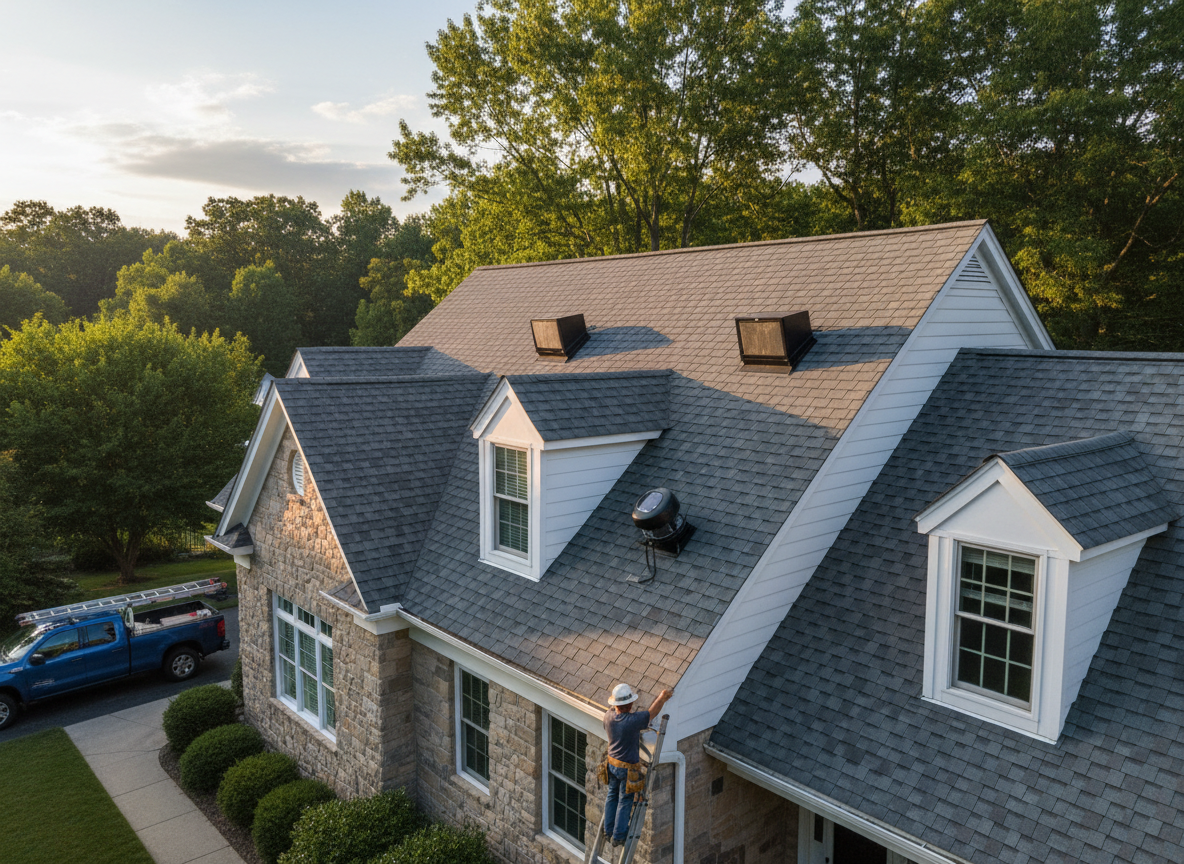
Residential roof ventilation systems combine continuous soffit intake with ridge or static exhaust so attic air exchanges at about 1 cubic foot per minute per square foot of floor area. That ratio keeps summer attic temperatures from soaring 40–60 degrees above outdoors and winter moisture from condensing on the underside of the deck. In Newtown Square, Edgemont, and Gradyville the same principle applies whether the house sits on a wooded lot near Tyler Arboretum or a flatter parcel closer to the Newtown Square Corporate Campus.
How Balanced Airflow Protects Delaware County Roofs
Most homes in Newtown Square were built between the 1950s and 1980s with 2x6 or 2x8 rafters and limited original venting. Those attics trap humid subtropical air that arrives with July heat and then freeze when January nights drop below 20 degrees. Without a clear intake path at the eaves and an unobstructed exhaust path at the peak, moist air condenses, saturates insulation, and shortens asphalt-shingle life by 5–8 years. Terrain matters too: steeper lots in Gradyville shed rain quickly but still need soffit vents kept clear of leaf litter from nearby woods. A properly sized system equalizes pressure so wind-driven rain does not push water under the shingles during nor’easters that also hit Media and Broomall. We see the same pattern on every asphalt shingle roof installation we complete: ventilation is not an add-on; it is part of the weather envelope.
Intake Vents, Exhaust Vents, and the 50/50 Rule
Intake happens at the lowest point—continuous soffit vents or individual under-eave vents that pull cooler outdoor air in. Exhaust happens at the highest point—ridge vents, roof louvers, or a handful of static vents. Code and manufacturer specs both call for roughly equal net-free area on each side; a 1,200-square-foot attic typically needs 4–6 square feet of net-free intake and the same amount of exhaust. Powered attic fans can over-ventilate and actually pull conditioned air from living space if the intake is undersized, so we rarely specify them on older Newtown Square colonials. Gable vents work on some ranch-style houses in Edgemont but leave dead-air pockets on hip roofs. When we replace a roof we always verify that existing soffits are open and that new ridge vent is cut to the full length of the peak, not just a short run. That detail is as important as the shingles themselves on any roof installation in Delaware County.
Seasonal Stresses Unique to This Climate
Hot, humid summers push attic temperatures past 140 degrees if ventilation is blocked; the heat cooks the underside of the shingles and accelerates granule loss. Cold winters reverse the problem: indoor moisture rises, hits a cold deck, and forms frost that later melts into the insulation. Ice dams form along the eaves when heat leaks into the attic and melts snow that then refreezes at the colder overhang. Homes near Wayne and Broomall see the same cycle. Proper ventilation plus adequate insulation at the attic floor keeps the roof deck within 10–15 degrees of outdoor temperature, which is the simplest way to stop both problems. After a heavy snow or wind event, the same airflow also dries the deck faster, reducing the chance of hidden leaks that later require storm damage roof repair.
Matching the System to Local Housing and Terrain
Cape Cods and split-levels common in Newtown Square often have short, steep roofs that leave little room for static vents; a full-length ridge vent is usually the cleanest solution. Larger colonials in Gradyville may already have gable vents that we leave in place only if they do not short-circuit the ridge. Soil and drainage around the foundation rarely affect the roof itself, but overhanging trees near Tyler Arboretum drop needles that clog soffit screens, so we specify larger mesh and recommend a twice-yearly cleaning. When a homeowner in Broomall or Media calls, we measure the actual attic volume rather than guessing from square footage, because cathedral ceilings and bonus rooms change the required net-free area. The goal is always a quiet, passive system that works 24 hours a day without electricity. Our shop at 3475 West Chester Pike is open Mon–Fri 8am–6pm and Sat 9am–2pm if you want to drop off photos of your existing vents.
Checking and Upgrading What You Already Have
Walk the attic on a hot afternoon: if it feels like an oven and you see no light at the eaves, intake is blocked. Look for dark staining on the underside of the sheathing or rusty nails—those are moisture signs. Outside, confirm that ridge vent is not painted shut and that soffit perforations are not covered by vinyl siding or bird nests. Adding a few extra static vents without opening the soffits usually makes the problem worse. A full roofing replacement is the cleanest time to get the numbers right, but many existing roofs can be improved with a day of soffit work and a new ridge cap. The result is a cooler attic in August, drier insulation in January, and shingles that last closer to their rated 25–30 years instead of failing early from heat and moisture.